If history has taught us one thing, it is that no system of government lasts forever. In fact most forms of government only last for a relatively short time before it is changed to something different, or even falls.
Think about it. The United States has a system of government that is arguably the oldest of all the developed countries. Since the adoption of our constitution, the Russians have changed hands many times, from a absolute monarchy Czarist Russia) to a republic (short lived) to a dictatorship (the USSR) under communism. Following the collapse of USSR a new semi-dictatorship was established in Russia. The Germans went from a Monarchy to republic after WWI and then a dictatorship under the Nazis to a Democratic Republic after WWII. The French threw out the monarchy and had a brief fling with a Republican government but then entered another monarchy under Napoleon Bonaparte and then back to a Republican government after his downfall. There was another change in government when the Germans defeated the French in WWII. The English moved from a powerful monarch with a vast empire to a purer form of a Republic, with the Monarch having only a ceremonial position and no say in government at all. A far cry from the days of Mad King George. China went from a monarchy to a dictatorial state under the communist after several iterations. And the story goes on.
The reason for the changes vary from country to country. Some changes were the result of invasion by foreign powers and some, in fact most, were really the result forces acting within the structure that brought it down.Very often the fall of a government to a foreign power is proceeded by a long history of corruption and decadence within, making the fall almost certain. Rome is good example.
The United States form of government, from it's founding, has been under threat a couple of times.
In 1812 the British were on the edge of reconquering American and taking it back into the fold. Only a heroic stand at Fort McKinley in Baltimore stopped that from happening. If we had lost there we might very well be flying the British flag now.
The nation was literally torn apart in 1860 when 13 southern states decided to destroy this nation by rebelling. They feared that the election of a Republican to the White House would not only stop the spread of slavery, which they desired to do, but might actually put an end to slavery all together. A bloody war was fought to hold the nation together. Thousands of lives were lost in effort to save this nation.
The nation changed as a result of the Civil War. Going into the war we were the united States of America.
The population, including those at, and graduates of, West Point, owed
more loyalty to their state than to the nation. Robert E Lee, who did
not own any slaves, felt that he could not fight against his state and
resigned his commission and joined the rebels. Almost all the southern
born officers in the U S army resigned and joined the Confederacy.
After the War we became the United States of America.
One nation, not a collection of semi-independent states. That was
significant change in the form of government. But, through it all we had
the corner stone of our contract with the government, the
Constitution.
The Civil War was probably the greatest threat to our form of government for a long time. Although one could argue that the Japanese threatened us when they attacked Pearl Harbor in 1941. But, they had no real plans to conquer the United States, just to get us out of the Pacific and let them establish their "Asian Sphere of Influence". They thought that wiping out the the Pacific Fleet would force the Americans to ask for peace and the Japanese could then go on their merry way to control all of Asia. Their evaluation of the American psychology at the time was simply that we did not have the stomach to fight.
Hitler had great plans, but no real way to carry them out. He made the mistake of taking on the Russians with the British still at his back. He opened up a two front war, which anybody who knows anything about this stuff can tell you that is a very bad idea. Of course, he then compounded his problems by declaring war on the greatest industrial power in the world, The United States. Just how dumb can one man get? American industrial power then fueled the war machine that brought victory in the Second World War.
As I noted earlier, a form of government can be changed abruptly by acts of war, rebellion or invasion of a foreign power, but it can also be changed slowly and almost unrecognizably by forces from within.
The United States has been changing since it's inception. Technology has driven vast changes in how the nation operates and sees itself. The railroad, the car, the plane, mass production have had a profound influence on the country. There were many social changes in the United States over the years. The Constitution provided a method for change to reflect changing times by the amendment process. Notable among these were the 13th and 14th amendments which outlawed slavery and made all people born in the United States, regardless of color, as full citizens. Also, the 19th amendment assured women's suffrage throughout the United States. Up until then it was up to each state to decide the matter.
Since then the courts at all levels have been staffed more and more with judges which are prone to stepping outside the limits placed on government by the Constitution and are literarily making new law. The liberals had found a way to get their programs implemented without having to go through the congress.
A good example of the differences between current and past courts is the comparison between women's suffrage and abortion. Neither of these issues are addressed in the Constitution. The older courts would not rule on suffrage. The Constitution didn't address it so the courts felt is an issue left to the states to decide. It was the opinion that the federal government had no right to interfere. It took an amendment to the Constitution to force suffrage on all the states. It should be mentioned that a lot of states already had suffrage. In the case of abortion, the courts (Roe vs Wade) held that it was unconstitutional to deny an abortion to any woman who wants one. Before that each state was free to decide this issue by the citizens of that state. There is no part of the Constitution, nor any law passed by the Congress, that addresses abortion on demand. Then the logic changed. The courts acted outside of the federal Constitution and in reality made a new law allowing abortion through the United States. A new right was discovered.
The downside for the abortion advocates is that Roe vs Wade can be overturned by a subsequent court. Of course suffrage can't because it written into the Constitution.
The courts
have been the vehicle for much of the changes that have been made to
the social contract between the government and it's people. In fact,
more and more the courts have taken the place of the legislative bodies
in deciding the course of the nation with regard to many social issues.
It seems that we are undergoing a restructuring
of our form of government. This morphing of the government, from a
nation based on the idea of freedom of the individual, individual
initiative, minimum government and adherent to the Constitution, into that of the government
providing a social network attempting to provide for the well being and comfort of all it's citizens and a new interpretation of the Constitution. That it is a fluid document and needs to be interpreted to fit societies desires at the time.
(Largely from Wikipedia) The changes in attitude about the role of government started during the Great Depression. As a solution to the Great Depression Roosevelt initiated a program called the New Deal. The New Deal was a series of programs, public work projects, financial reforms and regulations enacted in the United States 1933-36. Some of these federal programs included the Civilian Conservation Corps (CCC), the Civil Works Administration (CWA), the Farm Security Administration (FSA), the National Industrial Recovery Act of 1933 (NIRA) and the Social Security Administration
(SSA). The Grand Cooley Dam was built as part of the jobs program under the Roosevelt regime. Some of these programs had trouble in courts initially. They were declared unconstitutional. But, after an attempt to expand the court by Roosevelt and some public pressure, the court approved most of them. These programs included support for farmers, the unemployed,
youth and the elderly. It included new constraints and safeguards on the
banking industry and efforts to re-inflate the economy after prices had
fallen sharply. New Deal programs included both laws passed by
Congress as well as presidential executive orders during the first term
of the presidency of Franklin D. Roosevelt. The programs focused on what historians refer to as the "3 Rs": relief for the unemployed and poor, recovery of the economy back to normal levels and reform of the financial system to prevent a repeat depression. The New Deal produced a political realignment, making the Democratic Party
the majority (as well as the party that held the White House for seven
out of the nine presidential terms from 1933–1969) with its base in
liberal ideas, the South, traditional Democrats, big city machines and
the newly empowered labor unions and ethnic minorities. The Republicans
were split, with conservatives opposing the entire New Deal as hostile
to business and economic growth and liberals in support. The realignment
crystallized into the New Deal coalition that dominated presidential elections into the 1960s while the opposing conservative coalition largely controlled Congress in domestic affairs from 1937–1964. The Roosevelt New Deal and has been carried on and
expanded since.
This was a complete departure from previous government actions in the face of several recessions and an earlier great depression. Whether Roosevelt's programs helped or actually slowed down the recovery is open to debate. Many economists believe that he actually did more harm than good. In any event the general feeling was that Roosevelt was the savior of the country and he set up the Democrats to be viewed as the party of the working man. As a result of the Roosevelt programs, and their perceived success, a new role for government was now stamped into the American mind. That was never more evident than during the last recession where Obama took a page out of Roosevelt's play book and with a Democratic Congress, rammed through all kinds of bailouts for banks, investment houses and big corporations with the to big "To Big To Fail Label". A large infrastructure program was undertaken to provide jobs.
The courts have been the vehicle for much of the changes that have been made to the social contract between the government and it's people. In fact, more and more the courts have taken the place of the legislative bodies in deciding the course of the nation with regard to many social issues.
A current
bone of contention is the issue of gun control. The anti-gun faction is
doing everything it can to infringe upon the citizens right to bear
arms. This is a clear violation of 2nd Amendment to the Constitution,
which clearly states that the right of the citizen to keep and bear arms
shall not be infringed. So a great contest is being waged by the
supporters of the right to own a gun and those that want to eliminate
guns altogether from society. The problem the anti-gun lobby has is the 2nd
Amendment. The courts have gone a long way in supporting
restrictions on the sell and possession of guns. However, at this
point they have stood firmly against any attempt to outlaw guns
completely. You wonder how long that will last until a new interpretation of the Amendment is announced by a liberal court. After all, the Amendment includes the phrase "A well regulated Militia" as being the justification for its existence.
The question is----are the changes we are seeing and experiencing a precursor to a significant change in the nature of the government? Will the changes continue under social pressure from the liberals to the extent we end up completely ignoring the Constitution were we don't like it and embracing a Socialist form of government? I think the answer is---it is a definite possibility.
If you think about it, our government today would not be recognizable by the people who wrote the Constitution.
When one looks at the college campuses and what's going on there, it is easy to see where the nation seems to be heading. After all, these young people who are convinced that Socialism, as taught by their professors, is the right system to bring Truth, Justice and Prosperity to the people. They see problems of poverty, poor medical services and other ills in society and want to fix them. Never mind that every place it's been tried it has been a dreadful failure. They will not listen too, nor allow anyone else to listen too, any contradictory opinion to their own. These are the people who will be the politicians, the lawyers, the judges, and the reporters in a few years. Any student on campus who displays a Trump sign is likely to meet with bodily harm. They may not be the majority on campus, but they are the loudest and are backed overtly by their professors and the school administration.
Even grade schools are in the act. Eleven year old students are marched out of class, led by their teachers, and display signs prepared for them to protest some act of the President or the Congress on some subject; especially immigration. The liberal press eats that kind of thing up. They never bother to ask the students what they are protesting about. The answer wouldn't support the message the media is trying to make.
In a recent poll the question was asked if they were proud to be an American. Only 47% said that they were. If you compare that to a similar poll taken in 2003, 70% said they were proud to be an American. If you asked any of the Great Generation that same question, I would be surprised if that number didn't rise to almost 100%.
To add to the problem, not only do the liberals pretty much control the main stream media, but more importantly for the younger voter, they control the social media. You name it, Facebook, Twitter, Google, Microsoft; all owned and and run by liberals. You can't get a job with one of them if you are a conservative. In fact it was reported that Google marched one of their employees out the door for mouthing a conservative thought during the last election.
Illegal immigration has changed the face of America, especially in the states bordering the Mexican border. California, because of it's liberal policies, has attracted such a huge number of Latinos that they make up a majority of the population in many large cities, and about 47% of the total state. The once dominate Euro-centric white population is now the minority. This is having a profound impact on the Congress in addition to the local elections. Look at how many California Congressmen and women have Spanish surnames. Most of them have a liberal view of the role of government. The face of America has changed and will continue to change. And, the change seems to be toward a socialist approach of government, where all essential services such as medical and higher education is free, welfare is abundant and only the "Rich" have to pay.
The recent Trump revolution has halted some of that momentum, but I fear it's only a temporary pause. But, I guess we'll see.
When we wake up one day and find ourselves being taxed at about 80% of our income to pay for all the social programs so dear to the liberals heart and a stripping of our military to pay for it, we might be sorry we don't have any way to stop China and/or Russia from stepping all over us and our interests anywhere in the world.
Wednesday, July 11, 2018


Friday, June 29, 2018
Let's talk about Fascism.
The left loves to attach the term "Fascist" to the people that don't agree with them. Especially the Trump supporters and even the Republican voter in general. So, I thought it might be worthwhile to just look at what a Fascist believes in and how they compare to ideas of the conservatives who make up most of the Republican Party. And, to make that same comparison to the left and the Democratic Party.
The platform for Fascism was laid down in 1919 by a manifesto.
Let's see: Take the Fascist Platform one platform plank at a time and check it against the Democratic agenda (the left) and the Republican stance (the right) and see how it compares to both parties.
The Democrats fought against it and Wilson didn't want it.

So, which of two parties agree with the Fascists?
Left--Yes
Right--Yes
Both parties agree with the Fascists.
The right has it's radical fringe groups also, but they are not as numerous as the left and are generally disowned by the vast majority of the conservatives and certainly by the Party. And, they have not been violently disruptive and against any meeting or rally of the left wing. Look at the violent protests outside the Trump rallies during the elections. There were NO such protests outside the Bernie Sanders or Clinton rallies in the same time frame. The conservative treasures the first amendment to the constitution. So how do you score this?
Which of the two parties agree with the Fascists?
Left--Modified yes -say a half yes.
Right --No
Agreement with the Fascists?
Left--Yes
Right--Yes
Both parties agree with the Fascists.
Agreement with the Fascists?
Left--Yes
Right--NO
Agreement with the Fascists?
Left--Yes
Right----NO
Agreement with the Fascists?
Left---No
Right--No
On 25 June 1868, a Republican Congress passed an eight-hour law for federal employees] which was of limited effectiveness. It established an eight-hour workday for laborers and mechanics employed by the Federal Government. President Andrew Johnson had vetoed the act but it was passed over his veto. Johnson told a Workingman's party delegation that he couldn't directly commit himself to an eight-hour day, he nevertheless told the same delegation that he greatly favored the "shortest number of hours consistent with the interests of all." According to Richard F. Selcer, however, the intentions behind the law were "immediately frustrated" as wages were cut by 20%.
On 19 May 1869, President Ulysses Grant (a Republican) issued a National Eight Hour Law Proclamation. In the 1912 Presidential Election Teddy Roosevelts Progressive Party (Republican by another name) campaign platform included the eight-hour work day. The United States Adamson Act in 1916 established an eight-hour day, with additional pay for overtime, for railroad workers. This was the first federal law that regulated the hours of workers in private companies. The United States Supreme Court upheld the constitutionality of the Act in Wilson v. New, 243 U.S. 332 (1917).
The eight-hour day might have been realized for many working people in the US in 1937, when what became the Fair Labor Standards Act (29 U.S. Code Chapter 8) was first proposed under the New Deal (Dems). As enacted, the act applied to industries whose combined employment represented about twenty percent of the US labour force. In those industries, it set the maximum workweek at 40 hours, but provided that employees working beyond 40 hours a week would receive additional overtime bonus salaries.
So both parties have contributed to this stance on labor.
Agreement with the Fascists?
Left--Check
Right---Check
In 1933, the Roosevelt administration during the New Deal made the first attempt at establishing a national minimum wage regiment with the National Industrial Recovery Act, which set minimum wage and maximum hours on an industry and regional basis. The Supreme Court, however, in Schechter Poultry Corp. v. United States (1935) ruled the act unconstitutional, and the minimum wage regulations were abolished.Two years later after President Roosevelt's overwhelming reelection in 1936 and discussion of judicial reform, the Supreme Court took up the issue of labor legislation again in West Coast Hotel Co. v. Parrish (1937) and upheld the constitutionality of minimum wage legislation enacted by Washington state and overturned the Adkins decision which marked the end of the Lochner era. In 1938, the minimum wage was re-established pursuant to the Fair Labor Standards Act, this time at a uniform rate of $0.25 per hour ($4.78 in 2017 dollars. The Supreme Court upheld the Fair Labor Standards Act in United States v. Darby Lumber Co. (1941), holding that Congress had the power under the Commerce Clause to regulate employment conditions.
The 1938 minimum wage law only applied to "employees engaged in interstate commerce or in the production of goods for interstate commerce," but in amendments in 1961 and 1966, the federal minimum wage was extended (with slightly different rates) to employees in large retail and service enterprises, local transportation and construction, state and local government employees, as well as other smaller expansions; a grandfather clause in 1990 drew most employees into the purview of federal minimum wage policy, which now set the wage at $3.80.
In general the Republicans were not in favor of establishing a minimum wage. They believed that the market should determine the proper wages for work done.
Agreement with the Fascists?
Left--Yes
Right--No
The GOP does not believe it is the role of government to dictate such a mandate to business. Again, conservatives are committed to the concept of a free market and capitalism.
Agreement?
Left-Yes
Right--No
So how to score? Not exactly sure.
Agreement with the Fascists?
Left- A qualified no, Say half a no
Right---A qualified yes, Say half a yes
Agreement with Fascists?
Left--No
Right--No
Agreement with Fascists?
Dems --Yes
GOP--No
Agreement with Fascists?
Dems-No
GOP--No,sort of
Agree with the Fascists?
Left--No
Right--No
Agreement with the Fascists?
Left--Yes
Right--No
Agree with Fascists?
Left--No
Right--Maybe Yes
Agreement with Fascists?
Left--Yes
Right--No
Agreement with Fascists?
Left -Yes
Right--No
So what is the score? Who lines up with the Fascist agenda better; the liberal or the conservative? It seems that liberals and the Democrats agree with the Fascists on 10 points while conservatives and the Republicans only appear to agree on 4. It follows that if anyone should be called a Fascist is should be a liberal.
Being clear, that doesn't mean that the agreement is right or wrong. It just shows that calling the right "Fascists" isn't consistent with what a Fascist is and what they believe. Actually when you look at it, Fascism sounds a lot like Socialism.
One additional observation. If you add extreme antisemitism and the myth of Aryan superiority to the mix, you have Nazism. And, we all know where that led the world.
The platform for Fascism was laid down in 1919 by a manifesto.
The Fascist Manifesto of 1919 (From Wikipedia)
In 1919, Alceste De Ambris and Futurist movement leader Filippo Tommaso Marinetti created The Manifesto of the Italian Fasci of Combat (the Fascist Manifesto)] The Manifesto was presented on 6 June 1919 in the Fascist newspaper Il Popolo d'Italia. The Manifesto supported the creation of universal suffrage for both men and women (the latter being realized only partly in late 1925, with all opposition parties banned or disbanded); proportional representation on a regional basis; government representation through a corporatist system of "National Councils" of experts, selected from professionals and tradespeople, elected to represent and hold legislative power over their respective areas, including labour, industry, transportation, public health, communications, etc.; and the abolition of the Italian Senate. The Manifesto supported the creation of an eight-hour work day for all workers, a minimum wage, worker representation in industrial management, equal confidence in labour unions as in industrial executives and public servants, reorganization of the transportation sector, revision of the draft law on invalidity insurance, reduction of the retirement age from 65 to 55, a strong progressive tax on capital, confiscation of the property of religious institutions and abolishment of bishoprics and revision of military contracts to allow the government to seize 85% of their profits. It also called for the creation of a short-service national militia to serve defensive duties, nationalization of the armaments industry and a foreign policy designed to be peaceful but also competitive.Let's see: Take the Fascist Platform one platform plank at a time and check it against the Democratic agenda (the left) and the Republican stance (the right) and see how it compares to both parties.
- Universal Suffrage--
The Democrats fought against it and Wilson didn't want it.
So, which of two parties agree with the Fascists?
Left--Yes
Right--Yes
Both parties agree with the Fascists.
- All opposition parties disbanded (or made irrelevant).
The right has it's radical fringe groups also, but they are not as numerous as the left and are generally disowned by the vast majority of the conservatives and certainly by the Party. And, they have not been violently disruptive and against any meeting or rally of the left wing. Look at the violent protests outside the Trump rallies during the elections. There were NO such protests outside the Bernie Sanders or Clinton rallies in the same time frame. The conservative treasures the first amendment to the constitution. So how do you score this?
Which of the two parties agree with the Fascists?
Left--Modified yes -say a half yes.
Right --No
- Proportional representation on a regional basis.
Agreement with the Fascists?
Left--Yes
Right--Yes
Both parties agree with the Fascists.
- Government representation through a National Council of experts.---
Agreement with the Fascists?
Left--Yes
Right--NO
- Holding power over Labor industry, transportation, public health, communications, etc.-
Agreement with the Fascists?
Left--Yes
Right----NO
- Abolition of the Congress.
Agreement with the Fascists?
Left---No
Right--No
- Eight Hour Work week---
On 25 June 1868, a Republican Congress passed an eight-hour law for federal employees] which was of limited effectiveness. It established an eight-hour workday for laborers and mechanics employed by the Federal Government. President Andrew Johnson had vetoed the act but it was passed over his veto. Johnson told a Workingman's party delegation that he couldn't directly commit himself to an eight-hour day, he nevertheless told the same delegation that he greatly favored the "shortest number of hours consistent with the interests of all." According to Richard F. Selcer, however, the intentions behind the law were "immediately frustrated" as wages were cut by 20%.
On 19 May 1869, President Ulysses Grant (a Republican) issued a National Eight Hour Law Proclamation. In the 1912 Presidential Election Teddy Roosevelts Progressive Party (Republican by another name) campaign platform included the eight-hour work day. The United States Adamson Act in 1916 established an eight-hour day, with additional pay for overtime, for railroad workers. This was the first federal law that regulated the hours of workers in private companies. The United States Supreme Court upheld the constitutionality of the Act in Wilson v. New, 243 U.S. 332 (1917).
The eight-hour day might have been realized for many working people in the US in 1937, when what became the Fair Labor Standards Act (29 U.S. Code Chapter 8) was first proposed under the New Deal (Dems). As enacted, the act applied to industries whose combined employment represented about twenty percent of the US labour force. In those industries, it set the maximum workweek at 40 hours, but provided that employees working beyond 40 hours a week would receive additional overtime bonus salaries.
So both parties have contributed to this stance on labor.
Agreement with the Fascists?
Left--Check
Right---Check
- Minimum wage----
In 1933, the Roosevelt administration during the New Deal made the first attempt at establishing a national minimum wage regiment with the National Industrial Recovery Act, which set minimum wage and maximum hours on an industry and regional basis. The Supreme Court, however, in Schechter Poultry Corp. v. United States (1935) ruled the act unconstitutional, and the minimum wage regulations were abolished.Two years later after President Roosevelt's overwhelming reelection in 1936 and discussion of judicial reform, the Supreme Court took up the issue of labor legislation again in West Coast Hotel Co. v. Parrish (1937) and upheld the constitutionality of minimum wage legislation enacted by Washington state and overturned the Adkins decision which marked the end of the Lochner era. In 1938, the minimum wage was re-established pursuant to the Fair Labor Standards Act, this time at a uniform rate of $0.25 per hour ($4.78 in 2017 dollars. The Supreme Court upheld the Fair Labor Standards Act in United States v. Darby Lumber Co. (1941), holding that Congress had the power under the Commerce Clause to regulate employment conditions.
The 1938 minimum wage law only applied to "employees engaged in interstate commerce or in the production of goods for interstate commerce," but in amendments in 1961 and 1966, the federal minimum wage was extended (with slightly different rates) to employees in large retail and service enterprises, local transportation and construction, state and local government employees, as well as other smaller expansions; a grandfather clause in 1990 drew most employees into the purview of federal minimum wage policy, which now set the wage at $3.80.
In general the Republicans were not in favor of establishing a minimum wage. They believed that the market should determine the proper wages for work done.
Agreement with the Fascists?
Left--Yes
Right--No
- Worker representation in industrial management---
The GOP does not believe it is the role of government to dictate such a mandate to business. Again, conservatives are committed to the concept of a free market and capitalism.
Agreement?
Left-Yes
Right--No
- Revision of draft law on invalidity insurance
So how to score? Not exactly sure.
Agreement with the Fascists?
Left- A qualified no, Say half a no
Right---A qualified yes, Say half a yes
Agreement with Fascists?
Left--No
Right--No
- Strong progressive tax on capital----
Agreement with Fascists?
Dems --Yes
GOP--No
- Confiscation of the Property of religious institutions--
Agreement with Fascists?
Dems-No
GOP--No,sort of
- Abolishment of bishoprics---
Agree with the Fascists?
Left--No
Right--No
- Revise military contracts to seize 85% of all profits from such contracts.----
Agreement with the Fascists?
Left--Yes
Right--No
- Short service national militia for defense---
Agree with Fascists?
Left--No
Right--Maybe Yes
- Nationalization of the armaments industry---
Agreement with Fascists?
Left--Yes
Right--No
- A foreign policy designed to be peaceful---
Agreement with Fascists?
Left -Yes
Right--No
So what is the score? Who lines up with the Fascist agenda better; the liberal or the conservative? It seems that liberals and the Democrats agree with the Fascists on 10 points while conservatives and the Republicans only appear to agree on 4. It follows that if anyone should be called a Fascist is should be a liberal.
Being clear, that doesn't mean that the agreement is right or wrong. It just shows that calling the right "Fascists" isn't consistent with what a Fascist is and what they believe. Actually when you look at it, Fascism sounds a lot like Socialism.
One additional observation. If you add extreme antisemitism and the myth of Aryan superiority to the mix, you have Nazism. And, we all know where that led the world.
Sunday, June 10, 2018
The Role of Government
What is the role of government? That is a question that should be asked and answered for every citizen of the country. Just what do we want and expect our government to do?
Do you want government to be essentially your "Daddy" and you an everlasting dependent? Do you want "Daddy" to take care of you, tell you what is politically correct, what you should eat, who you should associate with, what you should think, what you should wear.? Don't laugh. In return you will be clothed and fed and given medical attention and try to keep you from being exposed to ideas that they consider harmful. We have many people in this country that have that basic belief, even though most don't recognize it. A quick look at the events occurring on our college campuses, especially the big Ivy League and California Universities should give you a clue.The most socialist of all the schools seems to be the Berkeley campus of the University of California where political dissent from socialist orthodoxy is put down, usually violently.
Before you answer that just consider a few things. The more you ask of your government, the more control that government will have over your lives and the greater the tax burden will be to pay for the things you want. There really is not such thing as a free lunch. Somebody pays. In spite of the ignorance of so many liberals that the money they want the government to spend on their free stuff is not money that just appears out of nowhere. It is taken, for force of law, from somebody who is working and producing something. Today the top 5% of the wage earners pay some 70% of the total tax burden. Some would increase the taxes on the rich so that the top 1% pay 90% of the nations income.
Do you want security? How much? Then, depending how much security you want, you must give up some, or a lot, of your freedom to achieve it. Police forces will have to be increased and given more power. Security check points will have to be expanded. Cameras positioned to monitor more areas will have to be installed. That's not the end. Laws will need to be passed giving more power to the government. The desire for absolute security will result in a police state.
Do you want the government to provide health care to the ones that can't, or don't want to, pay for private insurance? That issue is front and center today in the Congress as the debate over the repeal and replace of Obama Care is fought. Or should the government institute a one payer system where everybody is provided medical care at the taxpayers expense? There is certainly a push on, led by Bernie Sanders, to do that very thing. The cost is unknown and hasn't been evaluated by the GBO as far as I know. But, it will be expensive. I honestly believe that we are going to end up with that kind of program. Maybe not this go around, but not too far in the future. It will increase the proportion of the federal budget for entitlements to far greater percentage than it is now. You say Europe already has that kind of program, but they don't have the huge defense expenditures the United States has to act as an umbrella over the western world. And, if you don't think that is necessary, you haven't been paying attention to history lately.
Do you want to spend vast sums of the taxpayers money to "help" the poor as defined by some yardstick? What happens to "help" when it turns into entitlements that far to many people become dependent upon. Ignoring for the moment the effect on the nation as a whole, but on the individuals that are living on the dole. It has proved to be an anchor that keeps one generation after another chained to the welfare dole handed out by government bureaucrats. The government has literally created a permanent underclass with only a few able to break the chains of welfare and rise up in society. It's just too easy to take the "free" money that Uncle is handing out. As an example, single women are actually rewarded by having children by increasing the amount of their allotment for each child. That increases the number of young fatherless kids that are growing up and, far to often, getting into trouble.
A good yardstick to gauge how you feel is the catastrophe in south Texas and now Florida. The taxpayers are supplying a great deal of help in the immediate problems of rescuing people, trying to control the water levels and providing temporary relief to the victims in terms of shelter, food and other necessities. But, at what level should the taxpayers stop aid? Should they be responsible to rebuild the homes for the people that lost them in the hurricane and flood and not had the foresight to buy insurance to cover this eventuality, even though they clearly live in in a hurricane zone? Should the taxpayers poor huge sums of money into rebuilding the infra-structure of south Texas and Florida, including that infra-structure that is owned by private utility companies? What responsibility do the taxpayers of the nation assume for the individual states?
How about the environment? The government has stepped in big time to regulate businesses with the goal of keeping the environment clean. But, these regulations have been increasingly strict and have impacted the of creation of jobs. We have created an insatiable bureaucracy that sucks up huge sums of money while they search for the next regulation. To put the frosting on the cake they do not have to consider the fall out of their demands. There is no cost-benefit study done before new regulations are handed down. How big a role should the government have in setting environmental standards? Should they mandate the fuel consumption of cars and trucks? Why? Should the price you pay for natural gas and electricity be heavily influenced by the desire for you to lower your consumption of these items by adjusting rates so that larger users pay more per unit? Why? After all there is no economic reason to raise rates as the consumer uses more electricity or natural gas. Just the opposite. As more electricity or natural gas is produced, the lower the cost per unit. Large users should actually get lower rates as they increase their usage. Electricity is not a resource that is limited in quantity and is not threatened in the long term and there is so much natural gas that we are exporting it in vast quantities.
How about endangered species? Should the government prevent the expansion of homes and businesses because a rat is threatened, raising the cost of housing by limiting supply and jobs that would be created? Another bureau the the government has created that will never stop finding species to protect with no mandate to consider the costs of their regulation.
So what is the role of government?
It is clear that the founding fathers were very wary of large government. In fact they firmly believed that large government was the greatest threat to the freedom of the individual. Any reading of the Constitution would clearly show that. The Constitution and it's amendments clearly define the role of the federal government and the protections that every citizen has from intrusion by that government. The tenth amendment clearly restricts the federal government from any activity not specifically granted by the constitution. Stating clearly that all other things are reserved to the States and to the people.
The founding fathers clearly thought that the role of government was to provide for national defense, regulate interstate commerce, provide a postal service, and to assure the individual rights and liberties of all it's citizens. The government was empowered to make treaties and regulate foreign trade. Not much else. Certainly there is nothing in the Constitution that allows the federal government to take money from one person and give it to somebody else. Taxes are authorized by the Constitution to pay for such things as national defense, interstate commerce and Postal service (roads and infrastructure) and operation of the government itself. And, remember, the power to tax is the power to control.
We have two opposing views of what is allowed by the Constitution. The more conservative side believes that unless the Constitution allows it, the federal government shouldn't do it. On the other side you have the liberals who believe that unless the Constitution specifically forbids it, they should do it if they feel like it. Even if the Constitution specifically gives the power for some action to the people by the constitution, the liberals still feel that they know better and move to impose their will. Gun laws are a good example. The Constitution specifically states that the right of the citizen to keep and bare arms shall not be infringed.And yet there is a ongoing battle to infringe on the right of the people to bare arms. If the people as a whole would like to restrict the sale and possession of firearms they should modify the constitution.
As the government moves into the lives of more and more citizens we become closer and closer to becoming a socialist state. And, one should remember that there has never been a socialist country that has not degenerated into a authoritarian state.
So think carefully about what powers you wish to cede to the government about your lives, your freedom to say what you want, to go where you please, to open a business if you desire, to retain a significant percentage of the money you earn, assemble in peaceful protests against government policies, to work where you wish and other personal liberties that we enjoy-----but for how long?
It has been said that in any form of government is the seeds of it's own destruction. The chink in the armor of a democratic government is when the people realize they can vote themselves the treasure of the empire. We have already reached the first stage of the condition. Where do we go from here?
Do you want government to be essentially your "Daddy" and you an everlasting dependent? Do you want "Daddy" to take care of you, tell you what is politically correct, what you should eat, who you should associate with, what you should think, what you should wear.? Don't laugh. In return you will be clothed and fed and given medical attention and try to keep you from being exposed to ideas that they consider harmful. We have many people in this country that have that basic belief, even though most don't recognize it. A quick look at the events occurring on our college campuses, especially the big Ivy League and California Universities should give you a clue.The most socialist of all the schools seems to be the Berkeley campus of the University of California where political dissent from socialist orthodoxy is put down, usually violently.
Before you answer that just consider a few things. The more you ask of your government, the more control that government will have over your lives and the greater the tax burden will be to pay for the things you want. There really is not such thing as a free lunch. Somebody pays. In spite of the ignorance of so many liberals that the money they want the government to spend on their free stuff is not money that just appears out of nowhere. It is taken, for force of law, from somebody who is working and producing something. Today the top 5% of the wage earners pay some 70% of the total tax burden. Some would increase the taxes on the rich so that the top 1% pay 90% of the nations income.
Do you want security? How much? Then, depending how much security you want, you must give up some, or a lot, of your freedom to achieve it. Police forces will have to be increased and given more power. Security check points will have to be expanded. Cameras positioned to monitor more areas will have to be installed. That's not the end. Laws will need to be passed giving more power to the government. The desire for absolute security will result in a police state.
Do you want the government to provide health care to the ones that can't, or don't want to, pay for private insurance? That issue is front and center today in the Congress as the debate over the repeal and replace of Obama Care is fought. Or should the government institute a one payer system where everybody is provided medical care at the taxpayers expense? There is certainly a push on, led by Bernie Sanders, to do that very thing. The cost is unknown and hasn't been evaluated by the GBO as far as I know. But, it will be expensive. I honestly believe that we are going to end up with that kind of program. Maybe not this go around, but not too far in the future. It will increase the proportion of the federal budget for entitlements to far greater percentage than it is now. You say Europe already has that kind of program, but they don't have the huge defense expenditures the United States has to act as an umbrella over the western world. And, if you don't think that is necessary, you haven't been paying attention to history lately.
Do you want to spend vast sums of the taxpayers money to "help" the poor as defined by some yardstick? What happens to "help" when it turns into entitlements that far to many people become dependent upon. Ignoring for the moment the effect on the nation as a whole, but on the individuals that are living on the dole. It has proved to be an anchor that keeps one generation after another chained to the welfare dole handed out by government bureaucrats. The government has literally created a permanent underclass with only a few able to break the chains of welfare and rise up in society. It's just too easy to take the "free" money that Uncle is handing out. As an example, single women are actually rewarded by having children by increasing the amount of their allotment for each child. That increases the number of young fatherless kids that are growing up and, far to often, getting into trouble.
A good yardstick to gauge how you feel is the catastrophe in south Texas and now Florida. The taxpayers are supplying a great deal of help in the immediate problems of rescuing people, trying to control the water levels and providing temporary relief to the victims in terms of shelter, food and other necessities. But, at what level should the taxpayers stop aid? Should they be responsible to rebuild the homes for the people that lost them in the hurricane and flood and not had the foresight to buy insurance to cover this eventuality, even though they clearly live in in a hurricane zone? Should the taxpayers poor huge sums of money into rebuilding the infra-structure of south Texas and Florida, including that infra-structure that is owned by private utility companies? What responsibility do the taxpayers of the nation assume for the individual states?
How about the environment? The government has stepped in big time to regulate businesses with the goal of keeping the environment clean. But, these regulations have been increasingly strict and have impacted the of creation of jobs. We have created an insatiable bureaucracy that sucks up huge sums of money while they search for the next regulation. To put the frosting on the cake they do not have to consider the fall out of their demands. There is no cost-benefit study done before new regulations are handed down. How big a role should the government have in setting environmental standards? Should they mandate the fuel consumption of cars and trucks? Why? Should the price you pay for natural gas and electricity be heavily influenced by the desire for you to lower your consumption of these items by adjusting rates so that larger users pay more per unit? Why? After all there is no economic reason to raise rates as the consumer uses more electricity or natural gas. Just the opposite. As more electricity or natural gas is produced, the lower the cost per unit. Large users should actually get lower rates as they increase their usage. Electricity is not a resource that is limited in quantity and is not threatened in the long term and there is so much natural gas that we are exporting it in vast quantities.
How about endangered species? Should the government prevent the expansion of homes and businesses because a rat is threatened, raising the cost of housing by limiting supply and jobs that would be created? Another bureau the the government has created that will never stop finding species to protect with no mandate to consider the costs of their regulation.
So what is the role of government?
It is clear that the founding fathers were very wary of large government. In fact they firmly believed that large government was the greatest threat to the freedom of the individual. Any reading of the Constitution would clearly show that. The Constitution and it's amendments clearly define the role of the federal government and the protections that every citizen has from intrusion by that government. The tenth amendment clearly restricts the federal government from any activity not specifically granted by the constitution. Stating clearly that all other things are reserved to the States and to the people.
The founding fathers clearly thought that the role of government was to provide for national defense, regulate interstate commerce, provide a postal service, and to assure the individual rights and liberties of all it's citizens. The government was empowered to make treaties and regulate foreign trade. Not much else. Certainly there is nothing in the Constitution that allows the federal government to take money from one person and give it to somebody else. Taxes are authorized by the Constitution to pay for such things as national defense, interstate commerce and Postal service (roads and infrastructure) and operation of the government itself. And, remember, the power to tax is the power to control.
We have two opposing views of what is allowed by the Constitution. The more conservative side believes that unless the Constitution allows it, the federal government shouldn't do it. On the other side you have the liberals who believe that unless the Constitution specifically forbids it, they should do it if they feel like it. Even if the Constitution specifically gives the power for some action to the people by the constitution, the liberals still feel that they know better and move to impose their will. Gun laws are a good example. The Constitution specifically states that the right of the citizen to keep and bare arms shall not be infringed.And yet there is a ongoing battle to infringe on the right of the people to bare arms. If the people as a whole would like to restrict the sale and possession of firearms they should modify the constitution.
As the government moves into the lives of more and more citizens we become closer and closer to becoming a socialist state. And, one should remember that there has never been a socialist country that has not degenerated into a authoritarian state.
So think carefully about what powers you wish to cede to the government about your lives, your freedom to say what you want, to go where you please, to open a business if you desire, to retain a significant percentage of the money you earn, assemble in peaceful protests against government policies, to work where you wish and other personal liberties that we enjoy-----but for how long?
It has been said that in any form of government is the seeds of it's own destruction. The chink in the armor of a democratic government is when the people realize they can vote themselves the treasure of the empire. We have already reached the first stage of the condition. Where do we go from here?
Saturday, June 9, 2018
Are we alone?
Are we alone in this Galaxy, or even the universe? A question that has no answer right now or in the foreseeable future.
When you take several factors into account it is hard to imagine that we are alone. There are hundreds of billions of galaxies in the universe and in our Milky Way Galaxy alone there are hundreds of billion of stars. Orbiting around those stars are millions of rocky planets in the Goldilocks zone.
Water, the most essential element of life as we know it, is abundant. It seems to exist everywhere. Just recently the scientists believe they have found the presence of amino acids on Mars that are the building blocks of life.
But, we have never found life itself outside of earth. And, scientists have never been able to produce life from the same compounds that are known to be essential.
However, the amount of sky we can explore is limited, so the jury is still out.
Consider this. We, that is humans, are an accident. A freakishly unlikely accident. A series of events, that would be highly unlikely to be reproduced on another world, resulted in us, by us I mean a sentient being able to produce high technology.
First of all, we find ourselves in the Goldilocks band in our orbit around the Sun. Just the right distance for liquid water. Not that unusual.
Another fortunate characteristic is, we have a molten core which produces a magnetic field that protects us from the deadly cosmic radiation. That is common to all rocky planets, but we are just the right age to have a molten core with a solid crust. I.e not too old and not too young. Radiation exists everywhere in the galaxy. Without that magnetic field, life on the surface of the earth would be impossible. Life on Mars is impossible now because the molten core that it once had has cooled and solidified. The magnetic field has long since collapsed and cosmic rays bombard the surface.
Our Solar System is located at the edge of the galaxy at the outer edge of one of the spiral arms. Deeper into the galaxy, it is likely that cosmic radiation would be too intense for a higher form of life to flourish.
Back when the earth was young, it seems that a collision by another large object was so violent that a huge chunk of the earth was ripped away and became, after a few million years, our large moon. It is a large moon. It's relatively the largest in the solar system. Without that moon we wouldn't be here. It stabilized the earth's rotation around a stable axis. The earth once rotated at a rate of 4 hours per cycle. It's the reason we have had a constant near 24 hour rotation period for millions of years allowing the growth of higher level organisms. Of the millions of rocky planets in the Milky Way, how many of them are fortunate enough to have a large stabilizing moon? Unknown.
We live in one of the older and largest galaxies in the universe. As far as we can see we are not producing stars any more. But our time is only a split second in the total time line of the universe. Other planets in this galaxy and others may have already come and gone. After all, when our core cools off we are doomed.
The earth has undergone multiple mass extensions during it's life. Mass extensions always eliminate the current dominate species allowing a new form of life to emerge. The second to last mass extinction resulted in the rise of the dinosaurs who ruled the earth for over a hundred million years. The last mass extinction was likely caused by a huge comet or asteroid impacting the earth near what is now the Yucatan peninsula. This doomed the dinosaur to history. Without that event the mammal would never have been allowed to grow from a small little rodent like creature. The big guys would have just ate him.And, there is no way I can see the dinosaur evolving into a sentient creature. No need too.
We, that is Homo Sapiens, almost didn't make it according to people who study such things. We were close to extinction ourselves at one time in our birthplace, Africa.
When the first creature climbed out of the oceans onto land they had 4 appendages. Somehow 4 appendages turned out to be the optimal number, at least in our environment, so every air breathing creature except the insects and spiders who subsequently evolved from those primordial days have exactly that number. The 4 appendages turned out to be just the right amount for the development of upright posture that let our hands free for other things except moving and climbing trees. What if the first creature had 6 appendages, or only 2? Would that creature have evolved to an upright walking, big brained being that is us? Certainly not like us. The world would have been completely different.
The most fortunate evolution that produced Homo Sapiens is the development of the opposable thumb. Something that no other species on earth has. Without that feature, we would be forever at the level of an ape. Pretty smart, but not able to produce any kind of complex tool. Another freakish accident?
Of course the question arises; what made the first creatures leave the seas and come onto land? It was probably self preservation. The oceans were teeming with other creatures that love to eat. So, perhaps the first creatures to leave the oceans did so to escape the carnivores. But, what if in another world there were no such carnivorous creatures? Then there would be no reason for our distant ancestors to leave the comfort of the oceans.
It is likely that life actually developed on other planets in our galaxy and in the universe. The numbers say that it did happen. Not necessarily at the same time as we developed. After all, we are only 4 billion years old. However, I think that any such life would look nothing like us, even though we would likely have much of the same characteristics. They would likely be O2 breathers, although maybe not with lungs as we know them. Oxygen is essential for the burning of carbon based fuel, and it is likely that any life in this universe would be carbon based.
My conclusion. The universe and this galaxy is probably teaming with life, but I think that a level of sentience able to produce higher technology is exceedingly, and I mean exceedingly, rare. We may very well be unique in this galaxy and even, perhaps, the whole universe. Wouldn't that be something? We will likely never know.
There are few ways we might find out. Perhaps we will get some kind of signal from outer space indicating that a high level of intelligence exists. Certainly we're constantly looking for such an indication.The only other way is--- to do to the impossible. Find a way to travel great distances much faster than light and go exploring. The UFO hunters will say it is possible because some other intelligent species has already done it and have visited earth many times in the past. If you believe that, I have a bridge in Brooklyn I would like to sell you. However, I've been wrong before, so we'll see.
When you take several factors into account it is hard to imagine that we are alone. There are hundreds of billions of galaxies in the universe and in our Milky Way Galaxy alone there are hundreds of billion of stars. Orbiting around those stars are millions of rocky planets in the Goldilocks zone.
Water, the most essential element of life as we know it, is abundant. It seems to exist everywhere. Just recently the scientists believe they have found the presence of amino acids on Mars that are the building blocks of life.
But, we have never found life itself outside of earth. And, scientists have never been able to produce life from the same compounds that are known to be essential.
However, the amount of sky we can explore is limited, so the jury is still out.
Consider this. We, that is humans, are an accident. A freakishly unlikely accident. A series of events, that would be highly unlikely to be reproduced on another world, resulted in us, by us I mean a sentient being able to produce high technology.
First of all, we find ourselves in the Goldilocks band in our orbit around the Sun. Just the right distance for liquid water. Not that unusual.
Another fortunate characteristic is, we have a molten core which produces a magnetic field that protects us from the deadly cosmic radiation. That is common to all rocky planets, but we are just the right age to have a molten core with a solid crust. I.e not too old and not too young. Radiation exists everywhere in the galaxy. Without that magnetic field, life on the surface of the earth would be impossible. Life on Mars is impossible now because the molten core that it once had has cooled and solidified. The magnetic field has long since collapsed and cosmic rays bombard the surface.
Our Solar System is located at the edge of the galaxy at the outer edge of one of the spiral arms. Deeper into the galaxy, it is likely that cosmic radiation would be too intense for a higher form of life to flourish.
Back when the earth was young, it seems that a collision by another large object was so violent that a huge chunk of the earth was ripped away and became, after a few million years, our large moon. It is a large moon. It's relatively the largest in the solar system. Without that moon we wouldn't be here. It stabilized the earth's rotation around a stable axis. The earth once rotated at a rate of 4 hours per cycle. It's the reason we have had a constant near 24 hour rotation period for millions of years allowing the growth of higher level organisms. Of the millions of rocky planets in the Milky Way, how many of them are fortunate enough to have a large stabilizing moon? Unknown.
We live in one of the older and largest galaxies in the universe. As far as we can see we are not producing stars any more. But our time is only a split second in the total time line of the universe. Other planets in this galaxy and others may have already come and gone. After all, when our core cools off we are doomed.
The earth has undergone multiple mass extensions during it's life. Mass extensions always eliminate the current dominate species allowing a new form of life to emerge. The second to last mass extinction resulted in the rise of the dinosaurs who ruled the earth for over a hundred million years. The last mass extinction was likely caused by a huge comet or asteroid impacting the earth near what is now the Yucatan peninsula. This doomed the dinosaur to history. Without that event the mammal would never have been allowed to grow from a small little rodent like creature. The big guys would have just ate him.And, there is no way I can see the dinosaur evolving into a sentient creature. No need too.
We, that is Homo Sapiens, almost didn't make it according to people who study such things. We were close to extinction ourselves at one time in our birthplace, Africa.
When the first creature climbed out of the oceans onto land they had 4 appendages. Somehow 4 appendages turned out to be the optimal number, at least in our environment, so every air breathing creature except the insects and spiders who subsequently evolved from those primordial days have exactly that number. The 4 appendages turned out to be just the right amount for the development of upright posture that let our hands free for other things except moving and climbing trees. What if the first creature had 6 appendages, or only 2? Would that creature have evolved to an upright walking, big brained being that is us? Certainly not like us. The world would have been completely different.
The most fortunate evolution that produced Homo Sapiens is the development of the opposable thumb. Something that no other species on earth has. Without that feature, we would be forever at the level of an ape. Pretty smart, but not able to produce any kind of complex tool. Another freakish accident?
Of course the question arises; what made the first creatures leave the seas and come onto land? It was probably self preservation. The oceans were teeming with other creatures that love to eat. So, perhaps the first creatures to leave the oceans did so to escape the carnivores. But, what if in another world there were no such carnivorous creatures? Then there would be no reason for our distant ancestors to leave the comfort of the oceans.
It is likely that life actually developed on other planets in our galaxy and in the universe. The numbers say that it did happen. Not necessarily at the same time as we developed. After all, we are only 4 billion years old. However, I think that any such life would look nothing like us, even though we would likely have much of the same characteristics. They would likely be O2 breathers, although maybe not with lungs as we know them. Oxygen is essential for the burning of carbon based fuel, and it is likely that any life in this universe would be carbon based.
My conclusion. The universe and this galaxy is probably teaming with life, but I think that a level of sentience able to produce higher technology is exceedingly, and I mean exceedingly, rare. We may very well be unique in this galaxy and even, perhaps, the whole universe. Wouldn't that be something? We will likely never know.
There are few ways we might find out. Perhaps we will get some kind of signal from outer space indicating that a high level of intelligence exists. Certainly we're constantly looking for such an indication.The only other way is--- to do to the impossible. Find a way to travel great distances much faster than light and go exploring. The UFO hunters will say it is possible because some other intelligent species has already done it and have visited earth many times in the past. If you believe that, I have a bridge in Brooklyn I would like to sell you. However, I've been wrong before, so we'll see.
Friday, June 8, 2018
Human Life; is it valuable?
Is Human life intrinsically valuable? I mean valuable in a sacred sense? The idea that taking of a human life is never justified. Such a position is held by some religious groups that would say that taking of life, on the battle field, in an execution for crimes, in an abortion procedure, or any other way, even in self defense, is wrong and immoral. However most people and religions don't share such a strict adherence to those kind of principles in practice. They allow the taking of life in some circumstances.
It is generally accepted that the value society places on human life is selective. Different societies,including religions, place value on some forms of human life and not on others. Different societies have different codes that decide the value of human life to them. Those codes don't necessarily translate across the boundaries into other societies. In fact seldom do. We don't say it that way, but that's what it reduces to.
What is gets down to, is the value of human life is essentially what society, as reflected by it's elected officials, by the vote or by a ruling dictator, decides it is.
If some society decides that's Okay to leave the elder to die when they no longer can contribute to the tribe, then that is what will be done. A common practice among some of the primitive peoples and practiced to some extent today in our modern society. It was justified as necessary for the survival of the tribe. And, some cases and primitive societies it probably was.
If society decides that some injuries sustained are too bad to fix, or some disability too severe to admit to the tribe because they can not contribute, it's Okay to just get rid of them. Nazi Germany took that stand. So did the ancient Spartans among others.
If they are are members of what is perceived to be an inferior race, then it's Okay to enslave them and kill them because their life has little intrinsic value. They may have value as property, but they have little intrinsic value as human beings. A civil war was fought over that issue.
The enemy on the battle field has little or no value, compared to mine, so it's Okay to kill them. More civilized societies have a code that says that once the enemy surrenders, then their value increases and it's no longer right or proper to kill. Although if was clear in WWII that the Japanese never shared that conviction. In fact, in their culture, surrendering just proves that the enemy was inferior and therefore deserves no compassion.
The value of the individual soldier in the military has value, basically, according to their rank. A good example is what went on in the Great War (WWI). Higher ranking officers, almost all from the British, French or German aristocracy sent thousands of men across no mans land in the face of withering machine gun and cannon fire, knowing that there was little chance of success. The common soldiers died by the thousands. But, they did it anyway time and time again. The common soldier had little human value to the officers ordering the attack, while sitting in their comfortable villas far from the action.
If a person doesn't believe in the same religion as my society or religion, their life has little or no value so we can kill them. We now have a large segment of Islam that fervently believes in the idea that the followers of their religion are the only one who have the right to live. Everyone else have no value as human beings.
The Man/Woman who commits murder or other heinous crimes have lost their value to society and that it's alright to execute them. Granted that some states have banned executions, but it wasn't because of the belief in the value of human life.
The fetus of unborn child has little value if it inconveniences the potential mother, and the mothers life is of greater value, so it's alright to terminate that fetus. We just recently witnessed an open election in Ireland, a very Catholic country, where a majority of the voters decided that the unborn child doesn't have an intrinsic value and can be terminated on request by the mother. The Irish came from all over the world in order to vote in that election. There was a huge support effort by the abortion forces in the United States to push for approval of this law. Although I'm not sure exactly what the abortion advocates of the United States have to do with the women of Ireland. The paradox is that most of these voters declare themselves as Christian. I guess that doesn't mean what it used to.
Of course the abortion advocates shroud their movement in nice sounding names, the most used is "woman's right to choose". That means the woman has the right to decide between the value of the fetus they are carrying and their own inconvenience. Sometimes it's "women's health", but the result is the same. In any event, it means that the unborn child, even up to moment of birth, has far less value than the potential mother.
Society has produced some strange paradoxes in our definition of the value of human life. It seems that most people who don't value the human fetus as having significant value, place great value on a criminal's life and are against executions. Some people won't eat meat because of ethical principles because they value the animals life highly, but will condone abortions because they value the life of the human fetus less.
The value of human life varies from society to society and over time. What is valued at one time is not in another, and vice versa. It is certain that this trend will continue. Something that is not acceptable today, might be okay tomorrow and our concept of the value of human life changes. Who knows, murder may become acceptable. Maybe it already has.
It is generally accepted that the value society places on human life is selective. Different societies,including religions, place value on some forms of human life and not on others. Different societies have different codes that decide the value of human life to them. Those codes don't necessarily translate across the boundaries into other societies. In fact seldom do. We don't say it that way, but that's what it reduces to.
What is gets down to, is the value of human life is essentially what society, as reflected by it's elected officials, by the vote or by a ruling dictator, decides it is.
If some society decides that's Okay to leave the elder to die when they no longer can contribute to the tribe, then that is what will be done. A common practice among some of the primitive peoples and practiced to some extent today in our modern society. It was justified as necessary for the survival of the tribe. And, some cases and primitive societies it probably was.
If society decides that some injuries sustained are too bad to fix, or some disability too severe to admit to the tribe because they can not contribute, it's Okay to just get rid of them. Nazi Germany took that stand. So did the ancient Spartans among others.
If they are are members of what is perceived to be an inferior race, then it's Okay to enslave them and kill them because their life has little intrinsic value. They may have value as property, but they have little intrinsic value as human beings. A civil war was fought over that issue.
The enemy on the battle field has little or no value, compared to mine, so it's Okay to kill them. More civilized societies have a code that says that once the enemy surrenders, then their value increases and it's no longer right or proper to kill. Although if was clear in WWII that the Japanese never shared that conviction. In fact, in their culture, surrendering just proves that the enemy was inferior and therefore deserves no compassion.
The value of the individual soldier in the military has value, basically, according to their rank. A good example is what went on in the Great War (WWI). Higher ranking officers, almost all from the British, French or German aristocracy sent thousands of men across no mans land in the face of withering machine gun and cannon fire, knowing that there was little chance of success. The common soldiers died by the thousands. But, they did it anyway time and time again. The common soldier had little human value to the officers ordering the attack, while sitting in their comfortable villas far from the action.
If a person doesn't believe in the same religion as my society or religion, their life has little or no value so we can kill them. We now have a large segment of Islam that fervently believes in the idea that the followers of their religion are the only one who have the right to live. Everyone else have no value as human beings.
The Man/Woman who commits murder or other heinous crimes have lost their value to society and that it's alright to execute them. Granted that some states have banned executions, but it wasn't because of the belief in the value of human life.
The fetus of unborn child has little value if it inconveniences the potential mother, and the mothers life is of greater value, so it's alright to terminate that fetus. We just recently witnessed an open election in Ireland, a very Catholic country, where a majority of the voters decided that the unborn child doesn't have an intrinsic value and can be terminated on request by the mother. The Irish came from all over the world in order to vote in that election. There was a huge support effort by the abortion forces in the United States to push for approval of this law. Although I'm not sure exactly what the abortion advocates of the United States have to do with the women of Ireland. The paradox is that most of these voters declare themselves as Christian. I guess that doesn't mean what it used to.
Of course the abortion advocates shroud their movement in nice sounding names, the most used is "woman's right to choose". That means the woman has the right to decide between the value of the fetus they are carrying and their own inconvenience. Sometimes it's "women's health", but the result is the same. In any event, it means that the unborn child, even up to moment of birth, has far less value than the potential mother.
Society has produced some strange paradoxes in our definition of the value of human life. It seems that most people who don't value the human fetus as having significant value, place great value on a criminal's life and are against executions. Some people won't eat meat because of ethical principles because they value the animals life highly, but will condone abortions because they value the life of the human fetus less.
The value of human life varies from society to society and over time. What is valued at one time is not in another, and vice versa. It is certain that this trend will continue. Something that is not acceptable today, might be okay tomorrow and our concept of the value of human life changes. Who knows, murder may become acceptable. Maybe it already has.
Saturday, May 5, 2018
Assault Rifles-What are they?
If you tune into your TV and watch the news of late you are sure to see marches, with signs prominently displayed, demanding that gun control laws be enacted to ban assault rifles. But, when asked what is the characteristics of the an assault rifle, they really have no idea what an assault rifle is.
It would help if the demonstrators had some idea of the guns they want to ban.
From Wikipedia:and the US Army:
An assault rifle is a selective-fire rifle that uses an intermediate cartridge and a detachable magazine. Assault rifles were first used during World War II. Though Western nations were slow to accept the assault rifle concept, by the end of the 20th century they had become the standard weapon in most of the world's armies, replacing full-powered rifles and sub-machine guns in most roles. Examples include the StG 44, AK-47 and the M16 rifle.
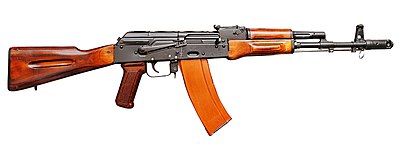
The most famous assault rifle--the AK-47
The term assault rifle is generally attributed to Adolf Hitler, who for propaganda purposes used the German word "Sturmgewehr" (which translates to "storm rifle" or "assault rifle"), as the new name for the MP43, subsequently known as the Sturmgewehr 44 or StG 44. However, other sources dispute that Hitler had much to do with coining the new name besides signing the production order. The StG 44 is generally considered the first selective fire military rifle to popularize the assault rifle concept.

The granddaddy of assault rifles: the Sturmgewehr 44
Today, the term assault rifle is used to define a class of firearms. The U.S. Army defines assault rifles as "short, compact,
selective-fire weapons that fire a cartridge intermediate in power
between submachine gun and rifle cartridges. In a strict definition, a firearm must have at least the following characteristics to be considered an assault rifle:
- It must be capable of selective fire. Including automatic fire.
- It must have an intermediate-power cartridge: more power than a pistol but less than a standard rifle or battle rifle, such as the 7.92×33mm Kurz, the 7.62x39mm and the 5.56x45mm NATO.
- Its ammunition must be supplied from a detachable box magazine. (It is common, but apparently not required, that all modern assault rifles have box magazines carrying 30 or so rounds of ammunition).
- It must have an effective range of at least 300 metres (330 yards).
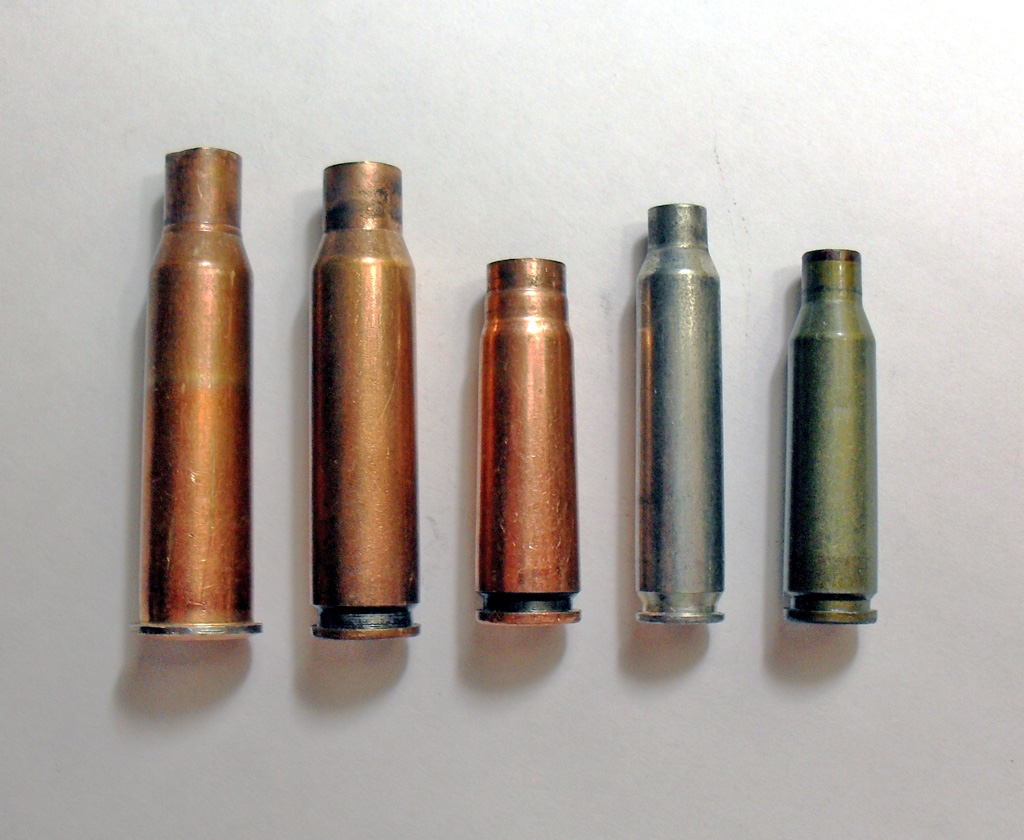
Service rifle cartridge cases: (Left to right) Full power cartridges 7.62×54mmR 7.62×51mm NATO Intermediate cartridges: 7.62×39mm 5.56×45mm NATO 5.45×39mm.
For Americans, not familiar with the metric system, 5.56 mm is about the same as a 22 caliber bullet. 7.62 mm is about the same as a 30 caliber round.
The much maligned M-16 was the US version of the assault rifle and was the standard issue rifle for the Army and Marines until it was replaced by the M4 Carbine.

M-16 Assault Rifle

M4 Carbine
Rifles that meet most of these criteria, but not all, are technically not assault rifles, despite frequently being called such.
For example:
- Select-fire M2 Carbines are not assault rifles; their effective range is only 200 yards.

M2 Carbine
Select-fire rifles such as the FN FAL battle rifle are not assault rifles; they fire full-powered rifle cartridges.

FN FAL Battle rifle
- Semi-automatic-only rifles like the Colt AR-15 are not assault rifles; they do not have select-fire capabilities. By the way the AR in the name doesn't stand for Assault Rifle. It stands for Armalite Rifle. Note the AR-15 only fires semi-automatic. It can not be switched to automatic fire. CNN's demonstration of the AR-15 as an assault rifle was laughable to say the least. And, the demonstrator pronounced that it was a "fully semi-automatic" rifle. What ever that means.

The AR-15
The AR-15 looks like an Assault Rifle, but it is just a common semi-automatic rifle. But, it does shoot the smaller intermediate round as opposed to the M1 Garand.
Semi-automatic-only rifles with fixed magazines like the SKS, and the WWII M1 Garand, are not assault rifles; they do not have detachable box magazines and are not capable of automatic fire.

The WWII standard semi-automatic rifle
Sometimes the M-14 is called an assault rifle, but it shoots a full-powered rifle shell, which makes it almost impossible to hold on target if being fired in the automatic mode. It is technically a Battle Rifle.

M14 Battle Rifle
In 1986, Congress passed the Firearm Owners Protection Act. It was supported by the National Rifle Association and individual gun rights advocates because it reversed many of the provisions of the GCA and protected gun owners' rights. It also banned ownership of unregistered fully automatic rifles and civilian purchase or sale of any such firearm made from that date forward.
Later, congress in it's infinite wisdom, redefined what an assault rifle is.
A Stockton, California, schoolyard shooting in 1989 led to passage of the Federal Assault Weapons Ban of 1994 (AWB or AWB 1994), which defined and banned the manufacture and transfer of "semiautomatic assault weapons" and "large capacity ammunition feeding devices."
Under the Assault Weapons Ban of 1994, the definition of "semiautomatic assault weapon" included specific semi-automatic firearm models by name; the AR-15 was named specifically, and other semi-automatic firearms that possessed two or more from a set certain features:
Semi-automatic rifles able to accept detachable magazines and two or more of the following:
- Folding or telescoping stock
- Pistol grip
- Bayonet mount
- Flash suppressor, or threaded barrel designed to accommodate one
- Grenade launcher
- Magazine that attaches outside the pistol grip
- Threaded barrel to attach barrel extender, flash suppressor, handgrip, or suppressor
- Barrel shroud safety feature that prevents burns to the operator
- Unloaded weight of 50 oz (1.4 kg) or more
- A semi-automatic version of a fully automatic firearm.
Semi-automatic shotguns with two or more of the following:
- Folding or telescoping stock
- Pistol grip
- Detachable magazine.
Tuesday, September 19, 2017
The Myth of the Popular Vote
The Dems like to trot out the official figures for the 2016 elections for President and note the Hillary actually beat Donald in the popular vote even though she was soundly defeated in the Electoral College. Does this mean that more Americans preferred Clinton over Trump? The answer is --ABSOLUTELY NOT.
Why is that? Let us examine how Presidential elections are handled. All candidates for the Presidency know that it is the Electoral College that needs to be won in order to win the office. So what do they do? They concentrate all their resources and time toward that end. They all employ huge staffs working toward that end and hire high priced consultants to map the road to victory headed by a Campaign Manager. They spend untold hours developing strategies based on expensive polls that they commission, in addition to the national polls that are a daily item in the media. So the entire strategy is aimed toward winning the Electoral College.
Using that strategy they concentrate their resources on so called purple states. That is, states that the campaign strategists consider up for grabs. The only reason they visit states they know they can't win or they consider in their pocket is for fund raising.
For instance, and the perfect example, Clinton nor Trump bothered to actually campaign in California, a state that is so Democratic in bleeds blue. The only reason Hillary showed up at all is to wring money from the rich folks in the bay area, Silicon Valley and the entertainment industry, all strong liberal centers and big supporters of the Dems.
California may be unique in that the people running for all state and federal offices, except President, are the two top vote getters from the primary election. I didn't look it up, so I don't know if other states hold their election the same way or not. I wouldn't be surprised if California stood alone in this type of ballot stuffing, but California isn't known as the land of fruits and nuts for no reason.
So, the ballot for the general election had a lot of offices except the President up for election with nothing but Democrats listed. As a side note, almost all state offices in California, such as Secretary of State, Attorney General, are elected. That was almost universal for those big population centers along the coast, stretching from the bay area south to the border. Republicans, in large numbers see no reason to go to the polls. It was a forgone conclusion that Clinton was going to win the Presidential vote in the state and the candidates for the Senate, House, state and local offices along the coasts were all Dems. Only when you get away from the big coastal centers into the interior of the state do you find a Republican presence. But, inland California does not have the population numbers as does the coastal cities.
So the largest state in the union with over 30 million people has pretty much made the Republicans outsiders to the political process for the moment. So in a system where the Electoral College elects the President, their vote has no weight at all. So they don't bother to vote. Most of them live in districts that are heavily Democratic so the their vote don't mean much for the state offices as well as federal.
That type of scenario is played out in other states, probably to lesser extent because they don't have Californians rigged system, where one party of the other has a commanding majority. The candidates spend no time in those states and the minority party is actually discouraged from even showing up at the polls because their vote is meaningless.
So the conclusion one has to reach is that the popular vote means virtually nothing and is not indicative of what most of people think or how they would have voted if they had a reason to vote. So even counting the popular vote on a nation wide basis has no meaning at all.
But what would happen if the Constitution where amended to change the Presidential election to the popular vote? The entire strategy for conducting a campaign would change. In the last election Trump would have campaigned in California and Clinton would have campaigned in Texas. But, they would not have spent any resources at all, of very little, in the smaller states. The partition of the states into red, blue and purple would have no meaning. The candidates would have to campaign where the votes are, i. e. the big population centers. And, the popular vote would have been quite a bit different for the 2016 election. This is not even a possibility now or in the foreseeable future. The small states wouldn't put up with it.
Under those rules the Republicans in California and New York would have a reason to vote. The Democrats in the so called Red states would have a reason to go to the polls.
Whether that's a good thing or not, the founding fathers considered that the election of the President by state rather than by popular vote to be the best choice. After all we are a nation of united states. It is intended that the states would retain all the power except that detailed in the Constitution. They were very much afraid, and rightly so, that if left to the popular vote, the large states would dominate the political process and sweep the small states aside. In the present environment the nation would be ruled by the coastal states with the great heartland of American largely ignored. That was what they wrote into the constitution and that is what the candidates have to live with.
The message is clear. The popular vote is not a meaningful measure of the population as a whole toward the election of the President.
QED
Why is that? Let us examine how Presidential elections are handled. All candidates for the Presidency know that it is the Electoral College that needs to be won in order to win the office. So what do they do? They concentrate all their resources and time toward that end. They all employ huge staffs working toward that end and hire high priced consultants to map the road to victory headed by a Campaign Manager. They spend untold hours developing strategies based on expensive polls that they commission, in addition to the national polls that are a daily item in the media. So the entire strategy is aimed toward winning the Electoral College.
Using that strategy they concentrate their resources on so called purple states. That is, states that the campaign strategists consider up for grabs. The only reason they visit states they know they can't win or they consider in their pocket is for fund raising.
For instance, and the perfect example, Clinton nor Trump bothered to actually campaign in California, a state that is so Democratic in bleeds blue. The only reason Hillary showed up at all is to wring money from the rich folks in the bay area, Silicon Valley and the entertainment industry, all strong liberal centers and big supporters of the Dems.
California may be unique in that the people running for all state and federal offices, except President, are the two top vote getters from the primary election. I didn't look it up, so I don't know if other states hold their election the same way or not. I wouldn't be surprised if California stood alone in this type of ballot stuffing, but California isn't known as the land of fruits and nuts for no reason.
So, the ballot for the general election had a lot of offices except the President up for election with nothing but Democrats listed. As a side note, almost all state offices in California, such as Secretary of State, Attorney General, are elected. That was almost universal for those big population centers along the coast, stretching from the bay area south to the border. Republicans, in large numbers see no reason to go to the polls. It was a forgone conclusion that Clinton was going to win the Presidential vote in the state and the candidates for the Senate, House, state and local offices along the coasts were all Dems. Only when you get away from the big coastal centers into the interior of the state do you find a Republican presence. But, inland California does not have the population numbers as does the coastal cities.
So the largest state in the union with over 30 million people has pretty much made the Republicans outsiders to the political process for the moment. So in a system where the Electoral College elects the President, their vote has no weight at all. So they don't bother to vote. Most of them live in districts that are heavily Democratic so the their vote don't mean much for the state offices as well as federal.
That type of scenario is played out in other states, probably to lesser extent because they don't have Californians rigged system, where one party of the other has a commanding majority. The candidates spend no time in those states and the minority party is actually discouraged from even showing up at the polls because their vote is meaningless.
So the conclusion one has to reach is that the popular vote means virtually nothing and is not indicative of what most of people think or how they would have voted if they had a reason to vote. So even counting the popular vote on a nation wide basis has no meaning at all.
But what would happen if the Constitution where amended to change the Presidential election to the popular vote? The entire strategy for conducting a campaign would change. In the last election Trump would have campaigned in California and Clinton would have campaigned in Texas. But, they would not have spent any resources at all, of very little, in the smaller states. The partition of the states into red, blue and purple would have no meaning. The candidates would have to campaign where the votes are, i. e. the big population centers. And, the popular vote would have been quite a bit different for the 2016 election. This is not even a possibility now or in the foreseeable future. The small states wouldn't put up with it.
Under those rules the Republicans in California and New York would have a reason to vote. The Democrats in the so called Red states would have a reason to go to the polls.
Whether that's a good thing or not, the founding fathers considered that the election of the President by state rather than by popular vote to be the best choice. After all we are a nation of united states. It is intended that the states would retain all the power except that detailed in the Constitution. They were very much afraid, and rightly so, that if left to the popular vote, the large states would dominate the political process and sweep the small states aside. In the present environment the nation would be ruled by the coastal states with the great heartland of American largely ignored. That was what they wrote into the constitution and that is what the candidates have to live with.
The message is clear. The popular vote is not a meaningful measure of the population as a whole toward the election of the President.
QED
Friday, September 8, 2017
North Korea and Kim Jong-un
There seems to be a consensus among the talking heads at the Fox News Network and CNN that North Korea, in the person of Kim Jung-un is crazy, or at least unstable. I think the characterization of the little guy with the funny haircut is far from true. If Kim is crazy he's crazy like a fox.
What he and his father Kim Jong-il and his grandfather Kim Il-Sung have done is played the western world, and the United States in particular, like a well tuned harp.
Perhaps a little review of the history will help. After WWII Korea, after being liberated from Japan, was occupied by two powers. By agreement the United States would occupy territory south of the 38th parallel and the Soviet Union would occupy north of that line. There was some talk about a general election to solidify the country which had the same outcome as the same promises by the Soviets concerning eastern Europe. The Soviets then established a puppet state in the north and named Kim il-Sung as the head. They thought they had a puppet they could control. Later, when they tried to replace him, they found that they had lost control of their puppet.
However, with the Soviets help the North was supported and armed with Soviet military equipment and advisors. The Chinese, glad to have a buffer between a western power and themselves were very supportive of North Korea.
That became really evident when the United Nations forces reached the Yalu River during the Korean War and the Chinese reacted with a huge force. They did not want a western leaning country bordering China. During the Korean War the Chinese warned the Americans not to cross the 38th parallel and move to the borders of China, but MacArthur chose to ignore the warnings. When you look at the present situation, it is evident that feeling is still the overriding consideration of the Chinese today. It drives their foreign policy concerning Korea and the United States/ They will not continence a western power at their borders. It overrides every other consideration. When we think that economics or sanctions will deter the Chinese from that stance, then we're just blowing smoke.
Early on the Kims, articulated by Kim Jong-il, developed the policy of Songun (military first). That policy has been picked up and carried forward by his son Kim Jong-un. As a result the North Koreans have the 4th largest military force in the world. Some 1,106,000 on active duty with 8,389,000 in reserve. They also have huge tank, artillery and mechanized forces. As we all know they now have developed nuclear weapons and the missile force to deliver them.
Why do they spend so much of their countries resources on the military and the hugely expensive program to develop nuclear weapons and ICBMs? The answer is simple. They want to insure that they will not be another Iraq. They watched what happened there and Kim doesn't want to be another Saddam. His position is quite clear. If Iraq had a nuclear arsenal, the Americans would have never have invaded the country. So he sees a nuclear capability and a means to deliver a bomb on the United States itself is the greatest deterrent for aggressive action against his country.
Kim Jong-il managed an agreement with Bill Clinton in 1994 to curtail his nuclear bomb program for aid. It isn't clear he ever did really comply as there was no means to monitor the program. But, when his father died, the push to develop an atomic bomb was accelerated under Kim Jong-un. The United States and most of the western world was decrying their pursuit of atomic weapons, threatening them with sanctions. But, all the wringing of hands by the western powers hasn't made a dent in their efforts. The pundits think that China should step in and put a stop to the effort, but China has it's own agenda. And. China isn't likely to stand by and allow western powers to move against North Korea militarily.
Now they have the bomb, even a thermonuclear version, and a long way toward perfecting the missiles to deliver that bomb directly to the American mainland. They have demonstrated that they can reach Japan already.
So the little guy with the funny haircut is sitting in pretty good position at the moment. He got there because of a lot of missteps by the United States since the end of WWII. I'm afraid we're in a pickle now. Damned if we do and Damned if we don't do something about North Korea. I don't think Kim is suicidal, so I don't think he would unilaterally launch an attack against the United States. But, the North Koreans could sell their technology to rogue nations that have a different view of the world.
What he and his father Kim Jong-il and his grandfather Kim Il-Sung have done is played the western world, and the United States in particular, like a well tuned harp.
Perhaps a little review of the history will help. After WWII Korea, after being liberated from Japan, was occupied by two powers. By agreement the United States would occupy territory south of the 38th parallel and the Soviet Union would occupy north of that line. There was some talk about a general election to solidify the country which had the same outcome as the same promises by the Soviets concerning eastern Europe. The Soviets then established a puppet state in the north and named Kim il-Sung as the head. They thought they had a puppet they could control. Later, when they tried to replace him, they found that they had lost control of their puppet.
However, with the Soviets help the North was supported and armed with Soviet military equipment and advisors. The Chinese, glad to have a buffer between a western power and themselves were very supportive of North Korea.
That became really evident when the United Nations forces reached the Yalu River during the Korean War and the Chinese reacted with a huge force. They did not want a western leaning country bordering China. During the Korean War the Chinese warned the Americans not to cross the 38th parallel and move to the borders of China, but MacArthur chose to ignore the warnings. When you look at the present situation, it is evident that feeling is still the overriding consideration of the Chinese today. It drives their foreign policy concerning Korea and the United States/ They will not continence a western power at their borders. It overrides every other consideration. When we think that economics or sanctions will deter the Chinese from that stance, then we're just blowing smoke.
Early on the Kims, articulated by Kim Jong-il, developed the policy of Songun (military first). That policy has been picked up and carried forward by his son Kim Jong-un. As a result the North Koreans have the 4th largest military force in the world. Some 1,106,000 on active duty with 8,389,000 in reserve. They also have huge tank, artillery and mechanized forces. As we all know they now have developed nuclear weapons and the missile force to deliver them.
Why do they spend so much of their countries resources on the military and the hugely expensive program to develop nuclear weapons and ICBMs? The answer is simple. They want to insure that they will not be another Iraq. They watched what happened there and Kim doesn't want to be another Saddam. His position is quite clear. If Iraq had a nuclear arsenal, the Americans would have never have invaded the country. So he sees a nuclear capability and a means to deliver a bomb on the United States itself is the greatest deterrent for aggressive action against his country.
Kim Jong-il managed an agreement with Bill Clinton in 1994 to curtail his nuclear bomb program for aid. It isn't clear he ever did really comply as there was no means to monitor the program. But, when his father died, the push to develop an atomic bomb was accelerated under Kim Jong-un. The United States and most of the western world was decrying their pursuit of atomic weapons, threatening them with sanctions. But, all the wringing of hands by the western powers hasn't made a dent in their efforts. The pundits think that China should step in and put a stop to the effort, but China has it's own agenda. And. China isn't likely to stand by and allow western powers to move against North Korea militarily.
Now they have the bomb, even a thermonuclear version, and a long way toward perfecting the missiles to deliver that bomb directly to the American mainland. They have demonstrated that they can reach Japan already.
So the little guy with the funny haircut is sitting in pretty good position at the moment. He got there because of a lot of missteps by the United States since the end of WWII. I'm afraid we're in a pickle now. Damned if we do and Damned if we don't do something about North Korea. I don't think Kim is suicidal, so I don't think he would unilaterally launch an attack against the United States. But, the North Koreans could sell their technology to rogue nations that have a different view of the world.
Subscribe to:
Posts (Atom)